17 January 2024
Super-Scaling the Superchain with Hyperlane
Super-Scaling the Superchain with Hyperlane

NoSleepJon
Summary
Superchain: a network of chains that share bridging, decentralized governance, upgrades, a communication layer and more — all built on…
“Superchain: a network of chains that share bridging, decentralized governance, upgrades, a communication layer and more — all built on the OP Stack.”
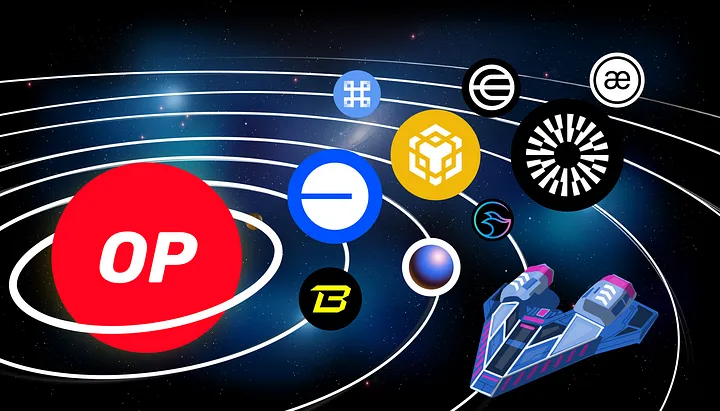
The Superchain is an ambitious scaling concept introduced by Optimism. It proposes a unified future with shared standards across infinite OP Stack rollups. But no one actually knows how we get to the Superchain. There’s so many moving parts. So many chains.
How do we advance from Superchain being just a myth to something real? All these rollups aren’t connecting themselves.
TLDR
Hyperlane’s permissionless and modular interoperability uniquely enables the Superchain. Importantly, it allows developers to:
- Easily connect their rollups to each other. Deploy Hyperlane out-of-the-box without needing permission from anyone.
- Leverage existing AND future security modules/proof systems to allow for a scalable, progressive path towards decentralization.
- Abstract away multichain complexities → unify the Superchain user experience.
What is the Superchain?

From Optimism: “Superchain: a network of chains that share bridging, decentralized governance, upgrades, a communication layer and more — all built on the OP Stack.”
But what does it actually mean?
The Superchain is like a federation: a group of partially self-governing states under a central federal government. Aligned states/chains opt in to shared governance and taxes/fees in exchange for interoperability + network effects + shared resources. Like the United States states and federal government system.
A unified Superchain offers many advantages:
- Shared standards and resources help compound the tech stack vs. fragmenting in a non-Superchain world.
- Easier and cheaper to launch new chains. No need to spin up new validator sets or block producers.
- Can enforce a higher standard of security models across Superchain rollups. Makes cross-chain apps possible without introducing systemic risk
- Improved user experience due to shared standards. Easier to abstract away the entire blockchain experience.
It sounds great in theory, but with all these new rollups comes the tradeoff of increasingly fragmented state and liquidity. So the logical next question is: How do we connect everything and avoid this fragmentation? Here’s our Hyperlane-flavored take:
How Hyperlane can super-scale the Superchain
Tools like the OP Stack make it easy for anyone to to launch their own rollup, but how does it connect to other rollups? This may not feel problematic today, but in a world where the Superchain thrives, connecting chains should be as easy as launching them. And that’s why we’re building Hyperlane.
What is Hyperlane exactly?
Hyperlane is the first universal and permissionless interoperability layer built to connect the modular ecosystem. With Hyperlane, anyone can connect any blockchain, rollup, appchain, on any VM. Hyperlane utilizes a modular security stack, meaning we separate the security layer from the interface. This allows for customizable security modules (Interchain Security Modules, in Hyperlane terminology, modular proofs in OP Stack terminology) to be used by developers using Hyperlane. We believe an initiative like the Superchain will require a form of interoperability that is both permissionless and modular, and Hyperlane was built with these ideas in mind:
Permissionless
Interoperability should be Permissionless. Needing to lobby or even pay bridge/interop teams to deploy on your chain is inefficient and simply not scalable. No one can wait for the core teams to manually deploy one chain at a time. And no one should need to play politics to have their chain connected. Interoperability should be Permissionless.
Most other interoperability protocols are non-starters because they require permission from specific operators (like core teams or validators) and thus add additional trust assumptions.
With Hyperlane, anyone can permissionlessly deploy interop on their OP Stack rollup with minimal changes.
Modular
Hyperlane’s modular approach to interoperability comes with many benefits:
- One interface for all interoperability. Different interchain security modules (ISMs) and bridges can be used under the same Hyperlane interface. Meaning anyone can integrate and access any native bridge and 3rd party interop provider complete with customizable security models; all with just one Hyperlane API.
- Customizable Security. Rollup deployers and application developers now have the option to leverage Hyperlane modular security to use the same messaging API with different ISMs to choose different security trade-offs to fit their use case.
- Specialization. Before, developers looking to build new security mechanisms (like ZK light clients) would need to also build the full stack of interoperability: a transport layer, a relaying layer, observability tools and other higher-level abstractions. With Hyperlane’s modular interoperability stack and infra providers like Kurtosis, they can now focus on just building those security mechanisms as interchangeable ISMs. For example, teams like Electron Labs and Succinct, are in the process of implementing their ZK stacks as ZK ISMs.
- Future proof. Developers using Hyperlane are able to adapt the security of their application or chain’s interchain communication to the needs of their users and as they grow without needing to upgrade to new interoperability solutions (since new ones can be easily Hooked in).
- Easier Testing. A modular messaging API also allows proof/ISM developers to easily iterate and test on existing chains without the need to run OP Stack forks.
The modular Hyperlane stack uniquely allows the flexibility for horizontally scaling ecosystems like the Superchain to scale. New chains can progressively decentralize their security and adopt more suitable security configurations with new ISMs.
Out-Of-The-Box Features
We already have multiple interchain use cases ready to go:
- Warp Routes are Hyperlane’s take on classic lock-and-mint token bridging. Like in Connext’s xERC20 standard, sovereignty is key. Asset issuers/application developers can fully customize the logic including the security model since they actually own the smart contracts (vs a centralized bridge controlling all the bridged asset contracts). Warp Routes come with an existing template UI out of the box that developers can customize and integrate into their application easily.
- Interchain Accounts (ICAs) enable developers to make remote function calls to any other chains, from one origin chain. Many use cases like DAOs owning assets on remote chains require 0 integration. Existing dapp frontends can be used with Safe or WalletConnection integrations of ICAs.
- The ISM and relayer infrastructure can be reused to bring oracles like Chainlink permissionlessly to any OP Stack chain.
Anybody can deploy Hyperlane to their own OP Stack chain by themselves. In addition, they are able to leverage Hyperlane’s increasing ecosystem of infrastructure service providers to avoid running their own infrastructure and/or decentralize available security models.
Building a rollup? Permissionlessly connect your rollup today with Hyperlane.
Interested in our detailed technical proposal for the Superchain? Read here.
More about Hyperlane
Hyperlane is the first Permissionless Interoperability layer, enabling anyone to connect any blockchain, out-of-the-box. With Hyperlane, developers can build Interchain Applications, apps that abstract away the complexity of interchain interactions and serve users on any connected chain. Additionally, Hyperlane’s modular security stack gives developers the power to customize their interchain security. Hyperlane development is open-source and led by core developers at Abacus Works.
Go Interchain with Hyperlane
Start building with our Docs.
Experiment with Hyperlane in 5 minutes with our Quickstarts.
Join our Discord if you have any questions.
Apply to join our crew Here.
Find us on Twitter.
Further Reading

April 15, 2026
Introducing Predicate Hooks: Compliant Bridging on Hyperlane
Predicate is now available as a Hook on Hyperlane Warp Routes. Any chain on Hyperlane can now require compliance verification — KYC, sanctions screening, geo checks — before a single token leaves the origin chain. Compliant users get a normal bridging experience. Non-compliant transfers are stopped before anything moves.
By
NoSleepJon
.png)

Connect With Hyperlane
Hyperlane-as-a-Service
Get in touch to learn how we can facilitate a Hyperlane deployment specific to your needs.
Newsletter
Subscribe for monthly
updates on Hyperlane